
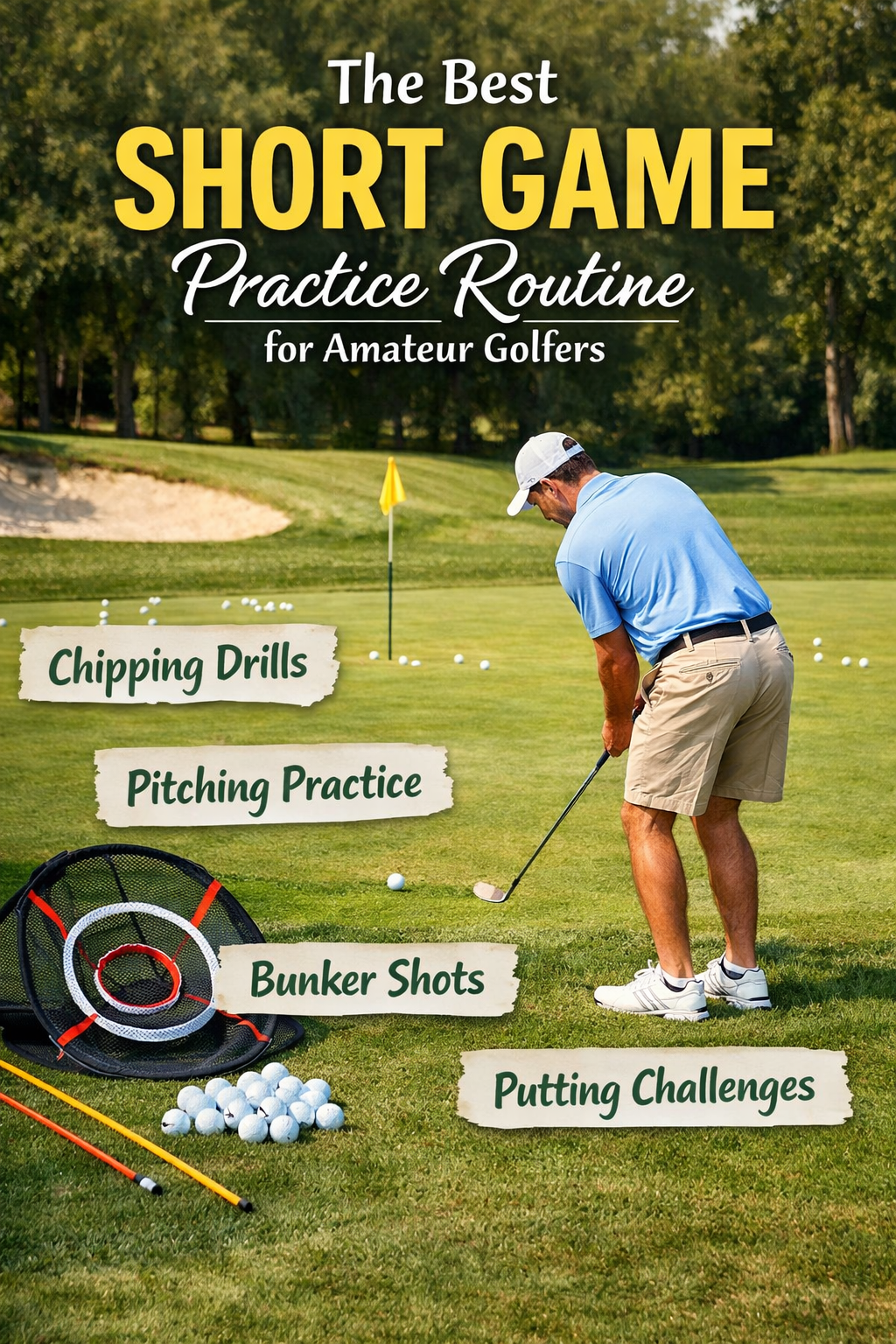

The Best Short Game Practice Routine for Amateur Golfers (Lower Your Scores Fast)
If you’re an amateur golfer trying to lower your scores, the fastest improvement doesn’t come from the driver — it comes from the short game. Roughly 60–65% of golf shots occur within 100 yards of the hole, yet most amateurs spend far more time on the driving range than the practice green.
A structured short game routine can quickly shave strokes off your scorecard by improving chipping, pitching, bunker play, and putting distance control.
This guide breaks down the best short game practice routine for amateur golfers so you can build confidence around the greens and start turning bogeys into pars.
Why the Short Game Matters for Amateur Golfers
Most amateur golfers lose strokes because of:
- Poor distance control on putts
- Inconsistent contact on chips
- Lack of touch from 30–80 yards
- Struggles escaping bunkers
Tour players get up-and-down about 60% of the time, while most amateurs are closer to 15–20%. The good news? Short game skills improve faster than full swing mechanics, meaning the payoff is huge with focused practice.
The 45-Minute Short Game Practice Routine
This simple routine focuses on real scoring skills, not just hitting balls aimlessly.
Practice Breakdown
| Skill | Time |
|---|---|
| Lag Putting | 10 minutes |
| Short Putts | 10 minutes |
| Chipping | 10 minutes |
| Pitch Shots | 10 minutes |
| Bunker Practice | 5 minutes |
Practicing in this order mirrors real course situations.

1. Lag Putting Drill (10 Minutes)
Most three-putts happen because of poor distance control, not bad aim.
Drill: The 3-Foot Circle
- Place tees in a 3-foot circle around the hole.
- Putt from 20–40 feet away.
- Goal: Stop every putt inside the circle.
Focus on:
- Smooth tempo
- Reading the green
- Speed control
If you eliminate three-putts, you can save 3–5 strokes per round.
2. Short Putting Drill (10 Minutes)
Inside 6 feet is where amateurs leak strokes.
Drill: The Clock Drill
Place balls around the hole like numbers on a clock:
- 3 feet away
- 8 different positions
Make all 8 putts before finishing the drill.
Benefits:
- Builds pressure
- Improves confidence
- Simulates real on-course situations
3. Chipping Routine (10 Minutes)
Great chippers use one consistent setup and motion.
Basic Chipping Keys
- Ball slightly back in stance
- Weight favoring lead foot
- Hands slightly ahead of ball
- Use a putting-style motion
Drill: Landing Spot Drill
- Place a towel 3 feet onto the green.
- Chip balls trying to land on the towel.
- Let the ball roll toward the hole.
Focus on landing the ball in the same spot every time.
4. Pitch Shot Practice (10 Minutes)
Pitch shots (30–80 yards) separate good players from average ones.
Ladder Distance Drill
Hit balls to targets at:
- 30 yards
- 50 yards
- 70 yards
Goal: land each ball past the previous distance without skipping one.
This drill improves:
- Distance control
- Trajectory control
- Wedge feel
5. Bunker Escape Drill (5 Minutes)
Many amateurs overthink bunker shots. The goal is simple:
Get the ball out and onto the green.
Drill: Line in the Sand
- Draw a line in the bunker.
- Place the ball just ahead of the line.
- Practice hitting the sand on the line.
Focus on:
- Open clubface
- Splashing sand
- Following through
If you hit the line consistently, bunker shots become much easier.
The Most Important Short Game Practice Tip
Practice with a purpose.
Instead of hitting 50 random chips, simulate real golf situations:
- Up-and-down challenges
- One-ball practice
- Pressure putting drills
A great practice goal:
Try to get up-and-down 5 out of 10 times before leaving the practice area.
Sample Weekly Short Game Practice Plan
3 Days Per Week
Day 1
- Putting distance control
- Short putts
- Chipping drills
Day 2
- Pitch shots
- Wedge distances
- Lag putting
Day 3
- Bunker practice
- Up-and-down challenges
- Pressure putting
Even 30–45 minutes per session can drastically improve scoring.
Common Short Game Mistakes Amateur Golfers Make
Avoid these mistakes when practicing:
1. Only hitting full wedges
Scoring happens from inside 80 yards.
2. Practicing from perfect lies
Real golf includes:
- Rough
- Tight lies
- Uphill/downhill shots
3. Ignoring putting practice
Putting accounts for around 40% of all strokes.
Final Thoughts
The fastest way for amateur golfers to lower scores is by mastering the short game.
A focused routine that includes putting, chipping, pitching, and bunker play can quickly turn missed greens into easy pars.
Commit to a structured practice plan, and you’ll start seeing:
- Fewer three-putts
- More up-and-down saves
- Lower scores
Remember:
Great golf isn’t about perfect drives — it’s about great recovery shots.